|
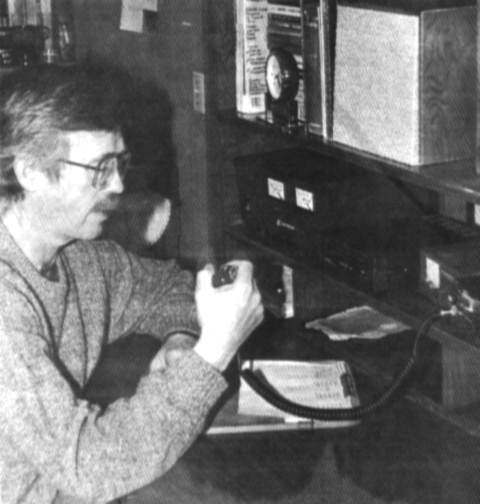
Dennis Rohlick, VE5AEE |
Local Ham Operator
|
|
Dennis Rohlick, VE5AEE |
Local Ham Operator
|
Melville's Volunteer Ready to Provide
Emergency Communications
|
Dennis
Rohlick talks to people from around the world. He's not an international
businessman. He's a ham radio operator. The
CN carman operates a ham radio from the upstairs bedroom of his Fourth Avenue
Melville home.
Rohlick
has a transceiver - transmitter, receiver - which operates on 13.8 volts
from an independent power supply. The system is worth in the neighbourhood
of $1,700.00 and helps him keep in touch with friends through-out the world.
(You can spend upwards of $6,000.00 for transceivers.)
He
says his station is basic, rather simple, but it doesn't prevent him from
picking up other operators in places like Central america, Japan and Australia.
Or like one of Rohlick's best friends who lives in Ontario.
He
credits his Ontarion friend with getting back into the hobby.
"I
was off the air for quite a few years because I was involved with committee
activities and I didn't have the time. However, my friend visited Melville
and got me interested in it again."
|
Rohlick
obtained his ham radio operator's license in 1981, but he was involved with
radios for many more years. He first became interested by reading about
ham radios in his father's Popular Mechanics magazines in the 1960s.
"I
was quite young but I read and became interested. There was a minister in
Melville who was a ham radio operator..I got talking to him one Sunday and
he took me into his station, showed me his equipment and let me listen for
awhile and I was hooked."
To
keep his license, he's required to pay a $32.00 annual fee. The cost is
minimal, the equipmnet aside. "If you watch and don't cause any interference,
they leave you alone. You have to log in every call, incoming and outgoing."
Getting
the license isn't all that easy, though he says he had to know Morse Code,
he had to know exactly how a transmitter and receiver work, and know what
the regulations are.
|
He
says he spends a lot of time talking on his ham radio, depending on the
weather. the ham signal is directly dependent on the atomospheric weather
conditions. "To get good signals depends on the time of day, the time of
year and the sunspot cycles", explains Rohlick.
"There
are plus and minus charges (ions) up there and it's such a vast space they
move around and never come together to form a single unit. So, when the
sunspots go they bring the charges closer together and the signals get better."
Besides
his friend in Ontario, Rohlick has talked to other interesting people. The
most interesting conversation, he says he's had was with a fellow in Birmingham,
Alabama. He's a retired carman who I just happened to pick up one day on
the radio. We talked for an hour and a half probably because we had a lot
more in common doing the same jobs."
So
what do you talk about with a total stranger who lives thousands of miles
away?
|
"You
usually talk about the weather and your radio, but two things you don't
talk about are religion and politics. You also don't swear on the radio."
Rohlick says it's a relaxing hobby and he plans to continue enjoying it
for many years.
"It's
a fun hobby. I've talked to guys in Australia, Japan, England, Ireland,
Spain and France without leaving my house. There are different things you
do with a ham radio, but I just like to sit and talk to people."
It
can also be more than a hobby. Rohlick says when a disaster occurs and communications
are cut, a ham radio operator can be the only form of communication with
the rest of the world.
Ham
radios can be operated with nothing more than a car battery. He was asked
years ago to be a part of the local EMO -- Emergency Measures Organization
-- but declined. However, he is interested in becoming involved now.
Rohlick
is also helping a local resident, Harvey Wirth, extablish a ham radio club
in Melville.
|