|
Paul Obetkoff, VE5PWO |
Saskatchewan
|
|
Paul Obetkoff, VE5PWO |
Saskatchewan
|
Kamsack Volunteer Ready to Provide Emergency Communications
|
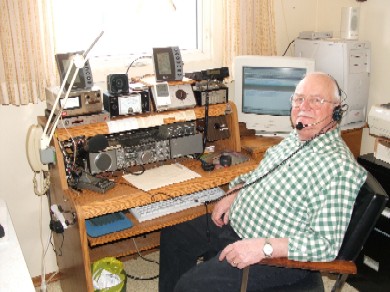
Should an emergency arise and traditional means of communications be disrupted, the skills developed by a Kamsack man during more than 30 years as a ham radio operator, will be pressed into service. Paul Obetkoff, a Kamsack native who returned to his home community in (1999) six years ago, after having retired from a career as a co-op manager, has been an amateur radio operator since acquiring his first license in 1972. A member of the Amateur Radio Emergency Service (ARES), Obetkoff is the service’s Saskatchewan emergency coordinator and is a member of the Canora Amateur Radio Club, which is obtaining funds from district communities to allow its members to swing into action, if and when the need arises. At its regular meeting last week, town council, accepting a recommendation of its Emergency Measures Organization, approved a donation of $100.00 to the club. The funds from Kamsack and other communities will allow the club to be in a position, so that members, in an emergency will be able to provide communication for fire, ambulance, police and rescue personnel. |
Discussing
his hobby on Tuesday while sitting at his desk in a room especially devoted
to amateur radio in his Using
equipment valued at $5,000.00 to $6,000.00, Obetkoff explains how he maintains
communications with other amateur radio operators and volunteers to be a
resource for such organizations as Environment Canada, which during times
of inclement weather, relies on amateur radio operators to provide and disseminate
information. He
is able to recount several incidents in the past 30 years, in which amateur
radio operators were indispensable in emergency situations. Obetkoff
explains how, if needed, his equipment can be taken from his home to his
vehicle and out to the field, to provide communication service. In
addition to promoting amateur radio in the district, Obetkoff and the Canora
club raise the funds for new equipment and for upgrades to existing equipment;
aim to raise awareness of amateur radio emergency services; communicate
with emergency measures personnel for improvement towards a more reliable
communication system, and encourage other persons interested in becoming
amateur radio operators. |
A trained
group of amateur radio operators willing to assist emergency services and
municipal agencies, ARES members are specialists in various forms of communication
modes from, computerized packet radio, long distance high frequency voice
and Morse code, UHF and VHF voice and even amateur television, the club’s
letter to town council said. To be an amateur radio operator, Industry
Club
members come from various walks of life including police, fire, and ambulance
services, doctors, nurses, lawyers, radio and computer technicians and former
military officers, it said. “In, exercise situations, we find ourselves
being radio resource persons for officials in command post and control group
locations.” Communications
are often cited as the weakest link in the command and control component
of an emergency, it said. In emergency situations, traditional systems
become overloaded or are disabled, and groups who normally don’t need radio
communications, such as social services, need it. |